

Key Points:
- Modeling in ABA therapy teaches new behaviors by showing the child exactly what to do through demonstration.
- This strategy is especially helpful for developing social, communication, and functional living skills in children with autism.
- Visual, live, and video modeling methods can all be adapted to fit the child’s learning style.
Children with autism spectrum disorder (ASD) often face challenges with imitation, which is a foundational skill for learning. When imitation doesn’t come naturally, they may need additional support to learn how to brush their teeth, greet others, or respond to questions. Modeling in ABA therapy provides that scaffold.
Instead of just telling a child what to do, therapists show the behavior step-by-step. This can be done in person (live modeling), with videos (video modeling), or using peers or family members. It’s a versatile and practical approach that supports a wide range of skill development, especially in real-world settings where visual cues often speak louder than words.
What is Modeling in ABA?
The modeling definition in ABA refers to the process of demonstrating a specific behavior so that a learner can imitate it. The goal is for the child to observe the behavior and then replicate it with support, eventually doing it independently.
This technique is often used in ABA therapy to teach communication strategies, social skills, self-help tasks, and classroom behavior. Modeling is an essential instructional strategy because many children with autism learn best through clear, visual examples rather than verbal instructions alone.
How Does Modeling Work in ABA?
Modeling in ABA therapy follows a structured but flexible process. The therapist first identifies a target behavior—something the child needs to learn. Then they demonstrate the behavior while the child watches. Afterward, the child is given a chance to imitate the behavior with support if needed.
The typical sequence includes:
- Select the skill to be taught (e.g., saying “hi” or washing hands).
- Demonstrate the exact behavior clearly and simply.
- Allow the child time to observe and process the model.
- Give the child a chance to imitate the behavior.
- Reinforce correct attempts and gently guide corrections if needed.
Over time, the child becomes more confident in using the skill independently, and modeling becomes less necessary.
What Types of Modeling are Used in ABA?
Modeling is not a one-size-fits-all approach. ABA therapists tailor it to the child’s needs, using different formats and tools depending on the skill being taught and the learner’s strengths. Below are several types of modeling commonly used in ABA:
1. Live Modeling
An adult or peer demonstrates the behavior in real-time, right in front of the child. This is effective for interactive skills like turn-taking or greetings.
2. Video Modeling
The child watches a video of someone performing the target behavior. This method can be paused, replayed, and used repeatedly, making it ideal for complex routines.
3. Peer Modeling
Another child—usually a sibling or peer—demonstrates the behavior. This adds a social element and can be especially motivating for children who are drawn to other kids.
4. Self-Modeling
The child watches a video of themselves performing the behavior (often edited for success). This builds self-confidence and reinforces ability.
5. Prompted or Assisted Modeling
When imitation is difficult, the adult may physically guide the child through the behavior after modeling it, gradually fading help over time.
Each method has its strengths, and many ABA programs use a combination to match the child’s learning style and the context of the skill.
What Skills Can Be Taught Through Modeling?
Modeling can be used to teach a wide range of essential life skills. It’s particularly effective for tasks that involve sequences, social norms, or physical actions that are easier to see than to explain.
Here are several skill areas often targeted:
1. Social Communication
Modeling helps children learn how to greet others, take turns in conversation, make eye contact, or respond appropriately in social settings. These observable interactions are easier to imitate than to understand through verbal instruction alone.
2. Functional Living Skills
Everyday tasks like brushing teeth, washing hands, or setting the table are often taught through modeling. Watching someone complete each step in sequence helps children grasp routines they may not yet understand verbally.
3. Classroom and Academic Behaviors
Behaviors like raising a hand, sitting quietly, or completing assignments can be modeled by peers or adults. Demonstrating these skills in context makes expectations clearer and encourages appropriate participation in school settings.
4. Safety and Community Skills
Crossing the street, staying close in public, or responding to a fire drill can be modeled to teach safety. Seeing the correct actions in real-world scenarios builds understanding and improves generalization across environments.
Modeling is especially useful in situations where behaviors can’t be easily explained or where words alone don’t stick.
Why is Modeling Effective for Children with Autism?
Modeling is effective for children with autism because it provides clear, visual examples of how to perform a behavior, reducing the need for complex verbal explanations. This approach aligns with many autistic children’s strengths in visual learning and imitation.
By watching a trusted adult or peer demonstrate a skill—like asking for help or brushing teeth—children can see exactly what is expected. Modeling also supports learning in social situations where abstract rules may be hard to grasp. It makes teaching more concrete, accessible, and easier to generalize across settings.
How Can Parents and Caregivers Use Modeling at Home?
You don’t have to be a therapist to use modeling effectively. Parents and caregivers play a huge role in helping children learn through everyday interactions. Below are practical ways to use modeling at home:
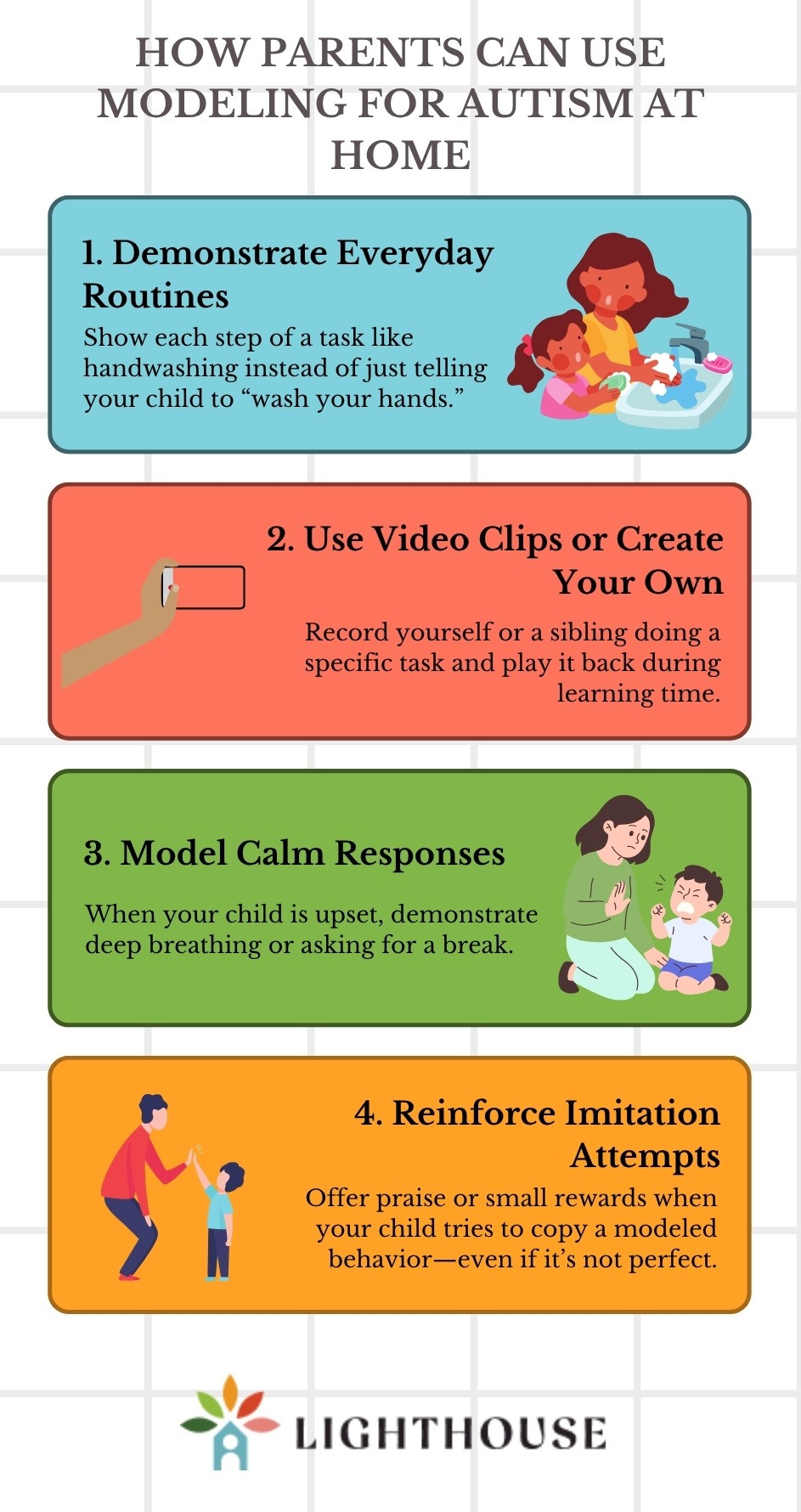 Using modeling consistently at home reinforces what’s learned during therapy sessions and helps generalize skills across environments.
What Makes Modeling in ABA Different from Typical Imitation?
Modeling in ABA is intentional and structured, focusing on teaching specific, functional behaviors rather than general copying. It’s used as part of a targeted intervention plan and often paired with prompts and reinforcement to support learning.
Unlike typical imitation, which may be spontaneous or playful, ABA modeling is goal-oriented. The modeled behavior is chosen based on the child’s needs, and success is measured by whether the child can perform the skill independently in relevant contexts.
What are the Limitations or Considerations of Modeling in ABA?
While modeling is a powerful tool, it isn’t always effective on its own. Some children with autism may struggle with attention, imitation, or generalization, making it necessary to combine modeling with other supports like prompts or reinforcement.
Additionally, the model must be clear, relevant, and engaging for the child. Poorly demonstrated or developmentally inappropriate behaviors may confuse rather than teach. For modeling to be successful, it should be part of a well-planned intervention tailored to the child’s learning style and needs.
Celebrate Small Wins With ABA Therapy
At Lighthouse, we use evidence-based strategies like modeling in ABA therapy to help children build real, functional skills they can use at home, in school, and in the community. Our therapists take the time to understand your child’s learning style and tailor demonstrations that are easy to follow and motivating to imitate.
Whether we’re teaching communication, routines, or daily living skills, our goal is to help your child thrive through consistent, visual learning in natural settings. ABA therapy in New York City should be practical, engaging, and built around your child’s strengths—and that’s what Lighthouse is committed to delivering.
Get in touch with us to learn how our team can support your child’s development through personalized ABA strategies, including modeling, in a warm and supportive environment.