

Key Points:
- Accurate data collection for autism supports effective intervention and tracks progress reliably.
- Various methods—like frequency counts, duration tracking, ABC charts, and permanent product data—serve different purposes.
- Consistency, clear definitions, and collaboration between parents and professionals ensure successful implementation.
Accurate data collection is essential for tailoring autism therapy to each child’s needs. According to the CDC, about 1 in 31 children in the U.S. are diagnosed with autism, making effective, individualized intervention more important than ever for families and providers alike.
In this article, we’ll go over best practices and tools for collecting accurate behavior data—from frequency counts to ABC charts—so families and professionals can better understand a child’s needs and celebrate meaningful milestones. Whether you’re a parent or provider, learning how to collect and use data effectively is key to supporting growth and long-term success.
What is Data Collection for Autism?
Data collection for autism refers to gathering objective, measurable information on behaviors, skills, and routines to guide intervention decisions and monitor progress. It helps families and clinicians understand how often a behavior occurs, how long it lasts, and under what circumstances.
Proper use of these methods ensures that interventions are effective, adjustments are data-driven, and meaningful outcomes are reached.
Why Use Different Data Collection Methods?
Each data collection method offers unique insights. Some are suited for tracking discrete behaviors; others capture duration or context. Choosing the right tool ensures you’re capturing meaningful information that aligns with your goals.
By combining methods—such as pairing frequency counts with ABC charts—you get a fuller picture: what’s happening, how often, and why.
How to Use Frequency Recording
Frequency recording is one of the simplest and most effective methods to track how often a behavior occurs within a set time. It’s ideal for behaviors that start and stop quickly, like hand flapping or requesting help.
Before starting, define the behavior clearly and set a time period, like during snack time or 30-minute play sessions.
Below are the steps to implement frequency recording:
- Choose a clear definition (e.g., “hand-flapping” = rapid movement of both hands).
- Set an observation period.
- Use a tally mark or clicker for each occurrence.
- Review weekly to see trends.
- Consistency in timing and clear definitions make frequency data reliable and informative.
When to Use Duration Recording
Duration recording captures how long a behavior lasts, instead of how often it occurs. It’s useful for behaviors like tantrums, on-task behavior, or ignoring tasks.
You’ll need a timer that starts when the behavior begins and stops when it ends. This method highlights whether interventions are reducing the length of challenging behaviors or extending positive ones.
Understanding ABC Tracking
ABC stands for Antecedent, Behavior, Consequence. This method captures context, not just frequency or duration. ABC tracking helps identify triggers and maintainers of behavior.
ABC chart example fields include:
- Antecedent (e.g., “asked to put away toys”)
- Behavior (e.g., “screams ‘No!’”)
- Consequence (e.g., “toy taken away for 10 seconds”)
Used consistently, this method reveals patterns, like what environmental factors prompt behavior and how responses impact future occurrences.
What is Permanent Product Data?
Permanent product data focuses on the results, not the behavior itself, such as the number of items placed in a bin, completed worksheets, or meals eaten. This method reduces observer bias and easily captures progress, especially with tasks that leave tangible evidence.
Examples of permanent product data include:
- Number of math problems solved.
- Items picked up in clean-up routines.
- Pieces of fruit eaten during snack time.
Collecting permanent product data offers concrete proof of progress and achievement.
When to Use Interval Recording
Interval recording monitors whether a behavior occurred during specific intervals within a session. It’s best for behaviors that occur frequently and without clear start/stop markers. You choose interval lengths (e.g., every 30 seconds), then mark if the behavior occurred at any point within that interval.
Variants of interval recording include:
- Whole interval: Behavior must occur the entire time.
- Partial interval: Any occurrence within the interval is marked.
- Momentary time sampling: Behavior must be happening at the exact moment the interval ends.
Interval recording offers a balance of structure and flexibility, making it suitable for social interaction, on-task behavior, or motor actions.
How to Choose the Right Data Collection Method
Choosing the right data collection method depends on the behavior you’re tracking and your intervention goals. For example, use frequency recording for behaviors that occur quickly, or duration tracking for behaviors that last over time.
Consider the context, clarity of the behavior, and who will be collecting the data. Simpler methods like tally marks or ABC charts work well for parents, while more complex tracking may suit clinical settings. The key is consistency and selecting a method that provides meaningful, actionable insights.
What Makes Data Collection Successful?
Successful data collection relies on clear behavior definitions, consistent recording methods, and regular analysis. Everyone involved should understand exactly what is being tracked and how to do it the same way every time.
Equally important is collaboration between caregivers and professionals. Regular check-ins, proper training, and accessible tools help ensure that data is reliable and useful. When done well, data collection becomes a powerful tool for guiding decisions and measuring meaningful progress.
Tips for Parents to Start Data Collection
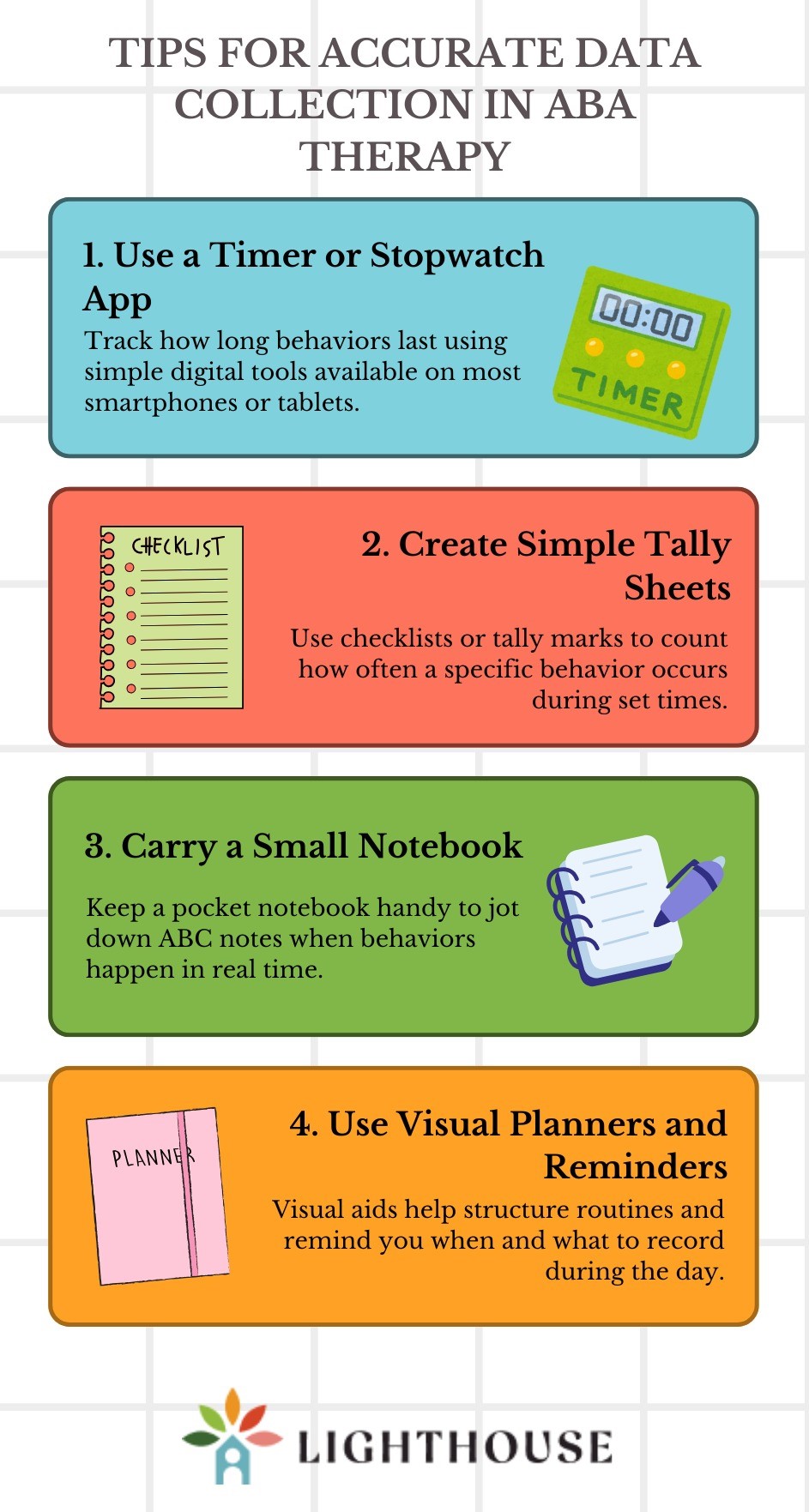
You don’t need to be a seasoned therapist to collect useful data at home. Start small, focus on cooperation, and use tools that fit your routine. Below are some practical tips to consider:
 Give Your Child the Tools to Succeed With ABA Therapy
Accurate data collection is central to delivering personalized ABA therapy. At Lighthouse, we guide families in implementing effective data tracking—whether it’s frequency, duration, ABC charts, or more. We help ensure that caregivers feel confident collecting and interpreting data, so your child continues making real progress every day.
We offer ABA therapy in New York City, blending professional support with tools your family can use in daily life. Our team values clear communication, practical tips, and regular check-ins to help data drive growth.
Contact us today to learn how we can support your family with structured data collection methods and meaningful ABA therapy at home.